
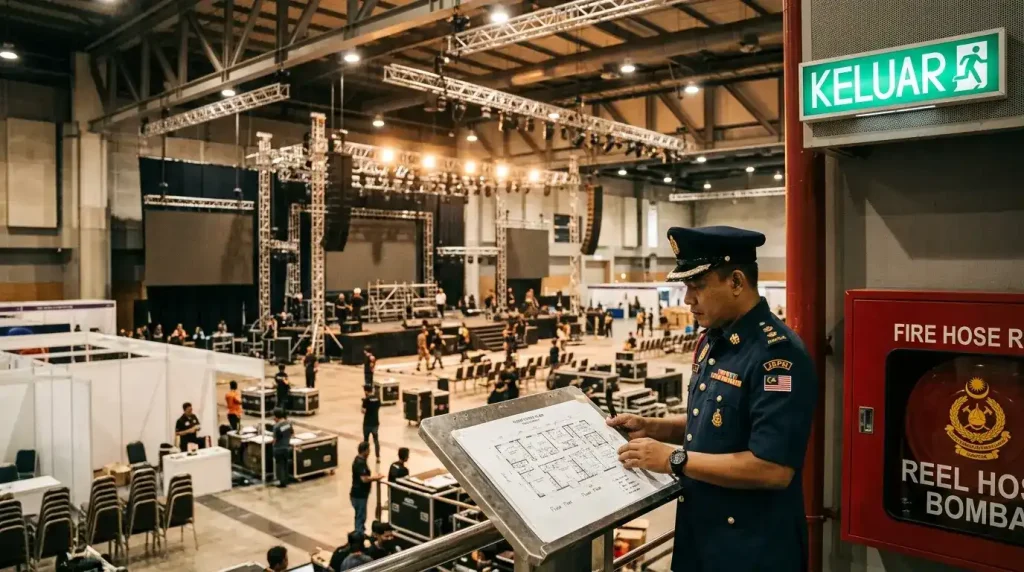
Bomba requirements for events in Malaysia are mainly triggered by three factors: crowd capacity, temporary structures, and pyrotechnics or special effects.
Large crowds, tents, stages, exhibition booths, and fire-related effects can all require review or clearance from the Jabatan Bomba dan Penyelamat Malaysia (JBPM), commonly known as Bomba. The exact requirements can vary based on the venue, event setup, building use, and local authority.
There is an important distinction that event organizers often miss. A venue may already have a valid Fire Certificate (Perakuan Bomba) for the building and its permanent fire protection systems.
That does not automatically mean your temporary event setup is covered. A tent in a car park, a stage inside a ballroom, an exhibition booth, or a pyrotechnics display can introduce new fire and evacuation risks that need to be reviewed separately.
Bomba involvement also forms part of the wider event approval process. Depending on the event and local authority, organizers may need a Surat Sokongan Bomba (Bomba Support Letter) as part of the documents required for the event permit application.
The exact process can differ between councils, so organizers should confirm the requirements with the relevant local authority and JBPM office before making final arrangements.
This is why fire safety should be handled during event planning, not on the day of the show. Blocked exits, covered hose reels, unsuitable temporary materials, or unapproved special effects can create problems during inspection and may delay or stop an event.
This guide breaks down what actually triggers Bomba involvement, which laws sit behind those rules, and the practical steps to get your event cleared without delays.
An experienced Event Management Company in Malaysia builds this into the planning process from day one, long before the guest list is finalized.
What Triggers Bomba Involvement for an Event
Three factors decide whether Bomba gets involved in your event. Crowd capacity is the most common trigger, since a large gathering changes the fire risk of any space.
Temporary structures come next, because tents, stages, and booths add fuel load and can block exits if built without a plan. Pyrotechnics and special effects are the third trigger, and they carry the strictest scrutiny of the three.
At a glance, the three triggers are:
- Crowd capacity that exceeds the venue’s normal occupancy load
- Temporary structures such as tents, stages, trussing, or exhibition booths
- Pyrotechnics or special effects, which trigger a separate approval chain of their own
There are two separate layers of compliance at play here, and organizers often confuse them. The first is the venue’s existing Fire Certificate, which covers the permanent building and its built-in systems.
The second is event-specific clearance for anything you add inside or around that building. A hotel ballroom can have a perfectly valid Fire Certificate and still fail an event-day inspection because a stage backdrop blocks a fire exit.
Exact crowd thresholds are not the same everywhere. They shift depending on the venue’s classification, the local fire and rescue zone office, and the layout of the specific hall or ground you are using.
Never assume a single national number applies to every venue. Confirm the threshold with the venue’s management and, where needed, the local JBPM office before you finalize your floor plan.
The Legal Basis: Fire Services Act 1988 and the Fire Certificate
Fire safety compliance in Malaysia runs through the Fire Services Act 1988 (Act 341). This is the law that gives Bomba its authority to inspect premises, issue certificates, and shut down activity that poses an immediate fire danger.
Under Section 28 of the Act, every designated premises must hold a Fire Certificate, known locally as Perakuan Bomba.
This applies to buildings the Director General has classified by use, size, or location, and it covers most hotels, convention centres, shopping complexes, and other high-occupancy venues used for large events. The certificate must be renewed every year under Section 29.
The Uniform Building By-Laws 1984 (UBBL), specifically its Tenth Schedule, is the technical table that decides which fire protection systems a building must install based on its size, height, and use.
This is the document architects and fire engineers use to work out whether a venue needs sprinklers, a fire command centre, or just extinguishers and hose reels.
Operating a designated premises without a valid Fire Certificate is an offence under Section 33 of the Act. Sources that have reviewed the amended provisions put the maximum penalty at a fine, imprisonment of up to five years, or both, with a further daily fine for as long as the breach continues.
If your event is booked into a venue, ask to see a current, unexpired Fire Certificate before you sign anything. Do not take the venue’s word for it.
Fire Protection Systems Malaysian Venues Are Required to Have
A compliant venue in Malaysia is built around a layered set of fire protection systems, not a single device. Portable fire extinguishers and hose reels handle a fire in its earliest stage.
Sprinklers, where required, control a fire automatically once it grows past that point.
Fire alarm and detection systems give occupants the earliest possible warning, and an automatic monitoring system called SPKA can connect that alarm directly to the nearest fire station without anyone dialling for help.
| System | What It Does |
| Portable fire extinguishers | First response to a small fire in its earliest seconds |
| Hose reel system | Occupant-operated water supply for fires still in the early stage |
| Sprinkler system | Automatic suppression once a fire grows past the early stage |
| Fire alarm and detection | Early warning to occupants so evacuation starts sooner |
| SPKA automatic monitoring | Sends an automatic signal to the nearest fire station |
Which of these systems a specific venue must have depends on the building’s size, height, and use as set out in the UBBL Tenth Schedule. A small conference room in a low-rise office building has very different obligations from a 10,000-pax convention hall. Ask your venue for a copy of their fire protection system schedule as part of your site visit, not as an afterthought once contracts are signed.
Hose Reel Bomba Requirement: What Organizers Actually Need to Check
The hose reel Bomba requirement in Malaysia is set out under Malaysian Standard MS 1489. Each hose reel is designed to cover roughly 30 metres of hose length, positioned so that no part of the protected floor area sits beyond that reach.
The hose loop itself sits at a set height off the floor, and the system draws from a dedicated water storage tank sized to keep multiple reels running at once during an incident.
None of that is something an event organizer needs to install. What matters on your side is much simpler. Never let booth walls, pipe-and-drape, signage, or stage decking block a hose reel cabinet or the path leading to it.
This happens more often than most organizers expect, especially in exhibition halls where booth builders are focused on visual impact and not on what sits behind the wall they just put up.
Walk your floor plan against the venue’s hose reel locations before build-out day, and make blocked access a non-negotiable item in your contractor briefing.
Bomba Requirements for the Building vs. Your Temporary Event Structure
The Bomba requirement for building Malaysia venues already met is covered under the Fire Certificate, and it works differently from what you add for your own event.
That certificate covers the building’s fixed fire compliance, its walls, exits, sprinklers, and alarms. What you add on top of that, meaning tents, stages, trussing, and exhibition booths, is your responsibility as the organizer.
| Covered By | Who Handles It | |
| Building structure, exits, sprinklers, alarms | Venue’s existing Fire Certificate | Venue management |
| Tents, stages, trussing, exhibition booths | Event-specific Surat Sokongan Bomba | Event organizer |
| Fabric, drapes, timber, and board materials in your build | Fire retardant material rules | Event organizer and booth contractor |
Fire retardant material rules apply directly to what you build. Fabric used for tents, drapes, and backdrops commonly needs to meet a flame-retardant standard such as DIN 4102 B1, and venue exhibitor manuals in Malaysia routinely state that lining, drapes, or overhead structures must be rendered non-flammable per Bomba’s requirement.
Timber and board materials used in booth construction typically need fire retardant treatment as well, and some materials such as MDF are treated differently from plywood in certain venue manuals because of how they behave in a fire test.
Always check the specific venue’s exhibitor manual rather than assuming one rule applies everywhere.
Floor plans submitted to the venue should mark exits, hose reel locations, and fire alarm panels clearly. This is not paperwork for its own sake. A floor plan without these marked is much harder for venue management and Bomba inspectors to approve quickly, and any oversight found during a walk-through can force last-minute rebuilds.
Whether you are building out a gala dinner in Malaysia or a full seminar stage, treat the floor plan as a fire safety document first and a seating chart second.
Pyrotechnics and Special Effects: A Separate Approval Chain
Pyrotechnics sit in their own approval category, separate from general venue and structure clearance. The Malaysian Government does not permit fireworks or pyrotechnic ignition outside a small set of approved circumstances. Formal government events, concerts, and events specifically approved by the Ministry of Home Affairs are the exceptions, and that Ministry approval is a policy decision rather than an automatic sign-off.
Once the Ministry grants that approval, the application still runs through several other agencies before ignition can happen.
The table below shows how the chain typically breaks down.
| Agency | What It Covers |
| Ministry of Home Affairs (KDN) | Policy-level approval for the event to feature pyrotechnics at all |
| Royal Malaysia Police (PDRM) | Security clearance for the display and the venue |
| Fire and Rescue Department (Bomba/JBPM) | Fire safety review of the display method, materials, and site |
| Civil Aviation Authority | Air traffic clearance where the display could affect nearby airspace |
Only operator companies approved by the Ministry are permitted to conduct a display, and the individual igniting the pyrotechnics must hold a certificate of expertise and a clean record.
Applications submitted late, or for events the Ministry considers unsuitable for ignition, are grounds for rejection.
Given how many agencies sit in this chain, start the pyrotechnics application process as early as possible in your event timeline, well before you lock in your run-of-show.
Means of Escape and On-Site Fire Safety Roles
Unobstructed exits are non-negotiable at any assembly-type event, whether that is a gala dinner, a product launch, or a trade show. Exit signage must stay visible at all times, and aisle widths in exhibition halls or banquet setups need to match what the venue’s occupancy plan allows. A stunning stage design means nothing if it narrows the main aisle to a width that would slow an evacuation.
For events held in a designated premises, the venue may already have a Fire Safety Manager or Fire Safety Officer on staff, since Bomba can require certain premises to maintain a fire safety organization as part of their ongoing compliance.
Confirm who that person is before your event and loop them into your run-of-show, especially for anything involving stage effects, large crowds, or a layout that changes the venue’s normal floor plan.
This is one of the details that separates a rushed event organizer in KL from one who has actually done this before.
Getting Bomba Clearance for Your Event: The Practical Sequence
JBPM event approval for a large-scale production follows a logical order, and skipping a step almost always costs you time later.
The sequence below is the order most organizers follow, from confirming what the venue already has in place to being ready for an inspector on the day.
- Confirm the venue’s Fire Certificate: Check that it is valid, unexpired, and actually covers the use you have planned for your event.
- Prepare a marked site or floor plan: Show exits, hose reel positions, fire alarm panels, and every temporary structure you intend to build.
- Submit your application to JBPM: Send your floor plan, company registration, and a detailed event program rundown to the nearest JBPM station or zone office. Most guidance points to starting this four to six weeks before your event date.
- Take the Surat Sokongan Bomba to your council: Attach it to your event permit application with DBKL, MBPJ, or MBSA, since these councils generally will not approve a permit without it.
- Coordinate with venue management throughout: Venues often run their own internal sign-off before anything reaches Bomba, so keep them looped in at every stage.
- Stay ready for an on-site inspection: This can happen during build-out or shortly before doors open, so make sure your crew knows an inspector may walk the floor.
This sequence overlaps heavily with the kind of coordination covered in our guide on event logistics planning, since fire safety approval is really just one more thread in the same timeline as freight, staffing, and vendor coordination.
Common Mistakes That Delay or Shut Down Events
Most fire safety problems on event day trace back to a small set of repeated mistakes.
The list below covers the ones that show up most often, and every one of them is preventable with a checklist and a reasonable lead time.
- Blocking hose reels or exits with booth builds: This usually happens because a contractor is focused on the visual layout and has not been told where the fire equipment sits.
- Untreated timber, MDF confusion, or unrated drapes: Stand builders often use whatever material is fastest to source rather than what the venue manual actually requires.
- Booking pyrotechnics without starting the approval chain early enough: This can sink an entire closing segment, since the Ministry of Home Affairs and Bomba chain involves multiple agencies and cannot be rushed.
- Missing or expired venue Fire Certificate documentation: This is the easiest one to avoid, since it only takes one phone call or one document request to confirm.
Pharmaceutical and compliance-heavy events feel this most acutely. Expert pharmaceutical meeting planners build fire compliance sign-off into their planning timeline from the very first site visit, not as a late add-on once the agenda is locked.
Fire safety and Bomba requirements for events in Malaysia are not a single form to file. They are a set of checks that run from the venue’s Fire Certificate down to the smallest booth wall, and they shift depending on your crowd size, your build, and whether pyrotechnics are part of the show.
Getting this right protects your guests, your budget, and your event date. Talk to our team early in your planning process, and we will map the fire safety and Bomba clearance steps your specific event actually needs.
Most Common FAQs on Bomba Requirements for Events in Malaysia
Does every event need separate Bomba approval, or does the venue’s Fire Certificate cover it?
No. That certificate only speaks to the building itself. Most large events still need a Surat Sokongan Bomba on top of it, and your local council will usually ask for this letter before it issues your event permit.
What happens if Bomba flags an issue on the day of the event?
An inspector can require an immediate fix, such as clearing a blocked exit, before allowing the event to proceed. In serious cases, they can restrict or halt the activity entirely until the issue is resolved.
Do outdoor events without a permanent structure still need fire extinguishers on site?
Yes. Outdoor events with tents, generators, cooking stations, or large crowds still carry fire risk, and organizers are generally expected to have basic fire extinguishing equipment on hand regardless of whether there is a permanent building.
How far in advance should pyrotechnics approval be started?
Start as early as possible, ideally several months out. The approval chain runs through the Ministry of Home Affairs, police, Bomba, and civil aviation authorities, and each agency needs its own processing time.
Does a rented marquee or tent need to be fire-rated in Malaysia?
Yes. Tent and marquee fabric used for events typically needs to meet a recognized flame-retardant standard, and venues commonly require proof of this before allowing the structure to go up.