
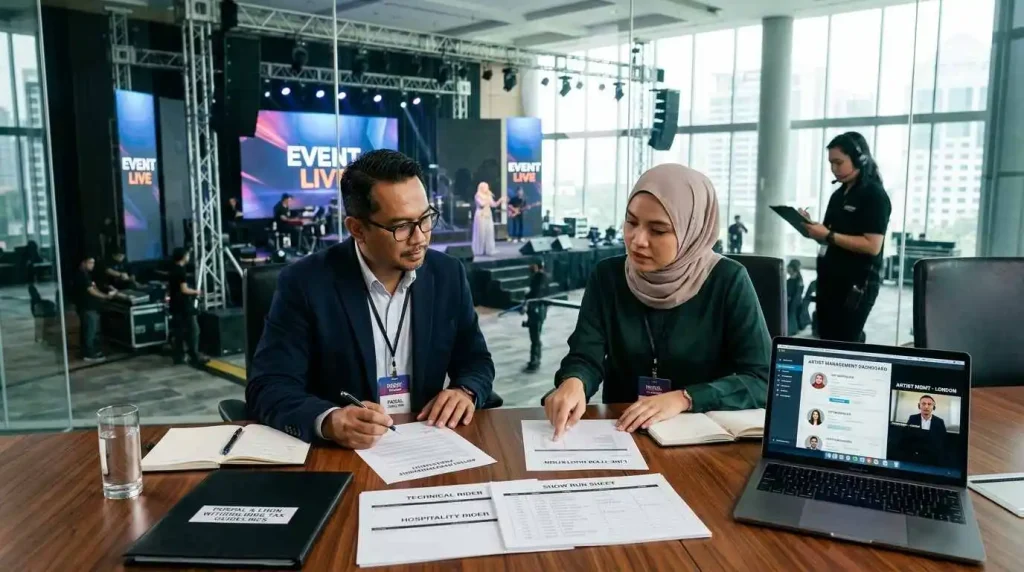
To choose an artist and talent management agency, check six things. Confirm direct access to the talent, PUSPAL, and tax handling, rider review, a complete quote, a named show-day lead, and proof of similar events.
Knowing how to choose an artist and talent management agency saves you money, time, and a lot of stress on show day. The right agency confirms the artist fast, reads the rider before quoting, and handles permits and tax for foreign acts. The wrong one adds hidden margins, misses deadlines, and leaves you alone backstage.
Here is the hard truth. Most bad bookings are not about the wrong artist. They are about the wrong middleman. Whether you handle company event planning in-house or hire an experienced talent management coordinator, the partner you pick decides how smoothly the night runs.
This blog covers the difference between agents and managers, what to put in your brief, the nine checks to run before you sign, how artist fees and withholding tax work, the rules for foreign talent, red flags, and a ready-to-send list of questions.
The Short Answer
A good artist management agency for events can reach the talent directly and handles PUSPAL approval and withholding tax for foreign acts.
It reads the rider before it quotes, gives you a complete quote with no surprise extras, names the person who runs the artist on show day, and can show you comparable events it has delivered. If an agency fails any of these six checks, keep looking.
- Direct access. The agency can confirm or place a hold on the artist without going through another broker.
- PUSPAL and withholding tax. The agency files the foreign artist paperwork and settles the 15% tax with LHDN.
- Rider first. The agency reads the artist’s rider before it sends you a price.
- Complete quote. The quote shows the full landed cost, not just the performance fee.
- Show-day lead. One named person manages the artist from arrival to departure.
- Comparable events. The agency can point to similar events, clients, and references.
Agency, Booking Agent, or Artist Manager: Who Actually Holds the Talent
Most event buyers never learn who does what in the talent world, and it costs them money. The question that matters is how many people sit between you and the artist.
Each role serves a different master. The table below shows the difference in plain terms.
| Role | Who They Work For | What They Do | What It Means for You |
| Artist manager | The artist | Guides the artist’s career, image, and big decisions | Often approves bookings but rarely handles event logistics |
| Booking agent | The artist | Sells the artist’s live dates and negotiates fees | Can confirm dates, but will not run your show |
| Talent management agency (Malaysian event context) | The event client and the talent | Books the talent, handles paperwork, and runs the artist on the day | One point of contact from quote to curtain call |
The debate over booking agent vs. artist manager matters less than the chain behind the name. An agency can call itself anything. What counts is how many layers sit between you and the performer. Every extra layer adds a margin and a delay.
Test it with two questions. Ask who signs the performance agreement. Then ask how long it takes to confirm a hold. A true representative can usually place a hold quickly. A middleman cannot place a hold at all, because they must ask someone else first.
Know What You’re Buying Before You Shortlist
Different talent categories are different businesses. An agency that is great at booking live bands may be weak at securing a celebrity emcee or a cultural troupe.
Match the talent to your event goal, not to who is famous. A name your CEO recognizes but your audience does not is money burned. The table below pairs common event types with talent that usually fits.
| Event Type | Main Goal | Talent That Usually Fits |
| Product launch | Buzz, media coverage, brand recall | Celebrity emcee, KOL appearance, a short high-impact opening act |
| Annual dinner | Staff fun and team spirit | Bilingual emcee, live band, lucky draw host, dance crew |
| Family day | All-age fun | Children’s shows, magicians, stilt walkers, cultural performers |
| Gala dinner | Prestige and a polished mood | Jazz ensemble, orchestra, professional emcee, a headline singer |
| Roadshow | Crowd pull at a public location | Emcee with strong crowd skills, dancers, interactive acts |
| Conference | Energy and credibility | Motivational speaker, professional moderator |
| Corporate party or after-party | Dancing and high energy | DJ, dance crew, live percussion act |
A quick search for “hire celebrity emcee Malaysia” returns dozens of names, but check language fit first. Malaysian audiences often need English, Bahasa Malaysia, or Mandarin, and sometimes all three. Genio’s own emcee roster covers all three languages for this reason. For launch-specific planning, see how we structure talent inside a full product launch.
A strong talent booking agency Malaysia buyers can trust will ask about your audience before it suggests a single name.

What to Send the Agency Before You Ask for a Quote
A clear brief gets you better options and a more accurate price. Agencies that receive vague requests send vague quotes.
Put these details in your first message.
- Date, time, and venue. Include the city and whether the venue is indoor or outdoor. This decides travel, permits, and technical needs.
- Audience profile. Share the guest count, age range, and main languages. This is how a good agency matches the act to the room.
- Event goal. Say whether you want buzz, fun, prestige, or motivation. The goal shapes the type of talent more than the budget does.
- Budget range. Give a realistic range, not a single number. It saves weeks of chasing names you cannot afford.
- Set length and slot. State how long the act performs and where it sits in your run of show. A 20-minute opener and a 90-minute headline set are priced very differently.
- Content limits. Mention any rules on language, jokes, dress, or song choices. Malaysian corporate audiences are mixed, so what works at a club may not suit a company dinner.
The Nine Things to Check Before You Sign
These nine checks separate a safe booking from a costly one. Run through each of them before you pay any deposit.
Direct Access to the Talent
Authorised representation means the agency has the right to book the artist, either directly or through the artist’s own team. A chain of brokers means your money and messages pass through several hands before they reach the performer.
Ask for proof in writing. A letter or email from the artist’s management confirming the agency can book them is enough. If the agency refuses or delays, treat it as a warning.
Roster Depth and Honest Alternatives
A good agency tells you when your first choice is out of budget or unavailable. Then it offers three real options that fit your audience and your money.
A weak agency keeps chasing the name you asked for. Weeks pass, the date gets closer, and you end up with a rushed last-minute pick. Honest advice early is worth more than a long roster list.
Malaysian Compliance, Handled or Handed Back to You
This is the biggest difference between Malaysian agencies. Foreign talent brings a stack of approvals, and someone must file each one on time.
Every foreign artist performance permit Malaysia grants starts with PUSPAL, the central agency under the Ministry of Communications. Only organizers registered with PUSPAL can apply.
The artist can only enter Malaysia after the Professional Visit Pass and, where needed, the Visa with Reference is approved.
| Requirement | Who Issues It | What It Covers | Key Point |
| PUSPAL approval | Ministry of Communications | Permission for a foreign artist or crew to perform | Guidelines ask for a complete new application no later than 30 days before the permit period starts |
| Professional Visit Pass (PVP) | Immigration Department | Short-term work entry for the artist and crew | Filed only after PUSPAL approval, while the artist is still outside Malaysia |
| Withholding tax (Section 109A) | LHDN | 15% tax on a non-resident entertainer’s fee | Must be paid before the artist’s permitted work period starts |
| Entertainment licence | Local council, such as DBKL | Permission to hold the performance at your venue | PUSPAL asks for a copy with the application |
| Music licensing | MACP, PPM, and RPM | Rights to perform songs and use recordings in public | Each body licenses on its own |
One update matters here. Music Rights Malaysia (MRM) used to handle music licensing as a single body. MRM has since been dissolved. Today MACP, PPM, and RPM license music users separately, so ignore old advice that tells you to apply to MRM.
Ask the agency one flat question. Which of these do you file, and which land on my desk?
Get the answer in writing. For fire safety approvals on large shows, our guide to Bomba requirements for big events covers the next layer.
Rider Literacy
A rider is the artist’s list of needs for the show. There are two kinds, and both affect your budget.
| Rider Type | What It Includes | Budget Impact |
| Technical rider | Stage plot, input list, monitors, backline (instruments and amps), power needs | Sound, stage, and equipment hire |
| Hospitality rider | Green room, meals, drinks, transport, hotel, entourage size | Catering, hotel rooms, ground transport |
Artist rider requirements can add a lot to the true cost of even a small act. An agency that quotes before reading the rider is quoting a number that will change. Always ask for the rider to be attached to the quote.
Contract Terms That Decide Your Risk
The contract decides who pays when things go wrong. Read these terms line by line before you sign.
| Term | What to Look For |
| Deposit schedule | How much you pay upfront and when |
| Balance timing | Whether the balance is due before or after the show |
| Cancellation tiers | What you lose if you cancel at 60, 30, or 7 days out |
| Force majeure | Which events cancel the deal without penalty, such as floods or government orders |
| Illness and no-show | Refund or replacement terms if the artist cannot perform |
| Substitution rights | Whether the agency can send a different performer, and who approves it |
| Exclusivity radius | Whether the artist can play a rival event nearby around your date |
| Recording and media rights | Whether you can film, stream, or post the performance |
| Insurance and liability | Who covers injury or damage during setup and the show |
Who Runs the Artist on the Day
Show day is where weak agencies get exposed. Ask who will manage the artist from arrival to departure.
You want one named artist liaison. That person handles the call sheet, transport, green room, security, and soundcheck timing. If the agency cannot give you a name, that is your answer.
Fit With Your Production Team
Talent and technical production must work as one team. A great singer still sounds bad through a poorly set up sound system.
Ask whether the agency talks directly to your AV, staging, and sound crew. Some agencies simply send the rider over and walk away.
Genio’s artist and talent management team works alongside our own in-house production crew, so the rider and the stage plan are built together. For a look at how this plays out, read what happens during concert and live event production.
What’s in the Quote and What Arrives Later
A low quote often means missing items. Those items come back later as extra invoices.
Ask for the all-in landed cost. It should cover the performance fee, travel, accommodation, per diems (daily meal allowance), entourage headcount, backline hire, any withholding tax gross-up, and the agency commission. If any line is missing, ask why.
Proof, Not Adjectives
Words like “premier” and “world-class” prove nothing. Ask for evidence you can check.
Request comparable events, named clients, and references you can actually call. A logo wall is not proof unless the agency can match each logo to real work.
How the Money Actually Works
Artist fees follow a simple pattern, but small details change the final bill. Knowing the structure helps you compare quotes fairly.
Most bookings follow a deposit-and-balance model. You pay a deposit to secure the date, and the balance is paid closer to the show. Before that, many artists offer a hold.
A hold is a soft reservation that keeps the date for you for a short time. Holds expire because the artist may have other offers waiting. If you do not confirm in time, the date goes to someone else.
Withholding tax is the part that surprises most buyers. According to LHDN’s withholding tax rules, under Section 109A of the Income Tax Act, a non-resident public entertainer’s fee is subject to 15% withholding tax.
LHDN’s definition covers singers, musicians, dancers, comperes, and even speakers giving a talk. The payer must pay this tax to LHDN, and late payment adds a 10% increase on the unpaid amount.
Now the gross-up trap. If the contract says the artist receives a net figure, you pay the tax on top.
Suppose a foreign singer’s contract promises RM85,000 net. The tax is worked out on the grossed-up fee. RM85,000 divided by 0.85 equals RM100,000. The tax is 15% of that, which is RM15,000. Your real cost is RM100,000, not RM85,000. PUSPAL’s own guidelines call this “tax on tax.”
For a wider view of event budgets, see our breakdown of event management costs in Malaysia.
Local vs. Foreign Talent: What Changes
Local talent is faster and simpler to book. Foreign talent can lift an event, but it brings extra steps, extra costs, and fixed deadlines.
| Factor | Local Talent | Foreign Talent |
| Who can apply | Not applicable | A Malaysian organizer registered with PUSPAL, with an LHDN income tax number |
| PUSPAL approval | Not needed | Required in Peninsular Malaysia |
| Work pass | Not needed | Professional Visit Pass, plus Visa with Reference where needed |
| Withholding tax | Not applicable under Section 109A | 15% of the fee, paid to LHDN |
| Official fees | None | RM500 per foreign artist and RM90 per crew member, as listed by the Immigration Department |
| Logistics | Simple local travel | Flights, hotels, entourage, freight for equipment |
| Currency risk | None | Fee may be in USD or another currency |
| Lead time | Can be short for available acts | Plan at least 12 weeks ahead |
Foreign talent is worth it when the draw justifies the extra work. A headliner who fills the room or brings media coverage can pay for itself. A foreign act your audience does not know usually cannot.
The work-back timeline below shows a safe plan for a foreign act. Official deadlines are marked. Everything else is good practice.
| Weeks Before Show | Task |
| 12 weeks | Shortlist talent, request holds, and confirm the agency is registered with PUSPAL |
| 10 weeks | Sign the performance agreement and pay the deposit |
| 8 weeks | Review both riders and lock the venue and entertainment licence plan |
| 7 to 6 weeks | Submit the PUSPAL application with all documents |
| 4 weeks (about 30 days) | Official cut-off for a new PUSPAL application before the permit period starts |
| After PUSPAL approval | File the Professional Visit Pass and any Visa with Reference |
| 2 weeks | Confirm LHDN tax figure and flights, and send the draft call sheet |
| Before the permit period starts | Pay the 15% withholding tax to LHDN (official requirement) |
| Show week | Final call sheet, airport pickup, soundcheck, show |
Red Flags
Some warning signs are easy to spot once you know them. If you see any of these, slow down.
- Pressure to pay before a signed agreement. A real agency sends the contract first and takes money second.
- No written confirmation of representation. If they cannot prove they can book the artist, they probably cannot.
- A quote with no rider attached. The price will change once the real needs appear.
- Vague answers on permits. “We will sort it out” is not a plan for PUSPAL or tax.
- No named on-site contact. Nobody in charge on the day means you are in charge.
- Logos with no matching case work. A client list means nothing without real events behind it.
Questions to Ask on the First Call
These are the questions to ask a talent agency before you commit. Copy them straight into your first email.
- Do you represent this artist directly, and can you confirm that in writing?
- How long does it take you to place and confirm a hold?
- Who signs the performance agreement on the artist’s side?
- Can you send the technical and hospitality riders with your quote?
- Is your quote the all-in landed cost, including travel, hotel, entourage, and backline?
- For foreign talent, is your company registered with PUSPAL, and do you file the application?
- Do you handle the Professional Visit Pass and the withholding tax payment to LHDN?
- Is the artist’s fee gross or net of withholding tax?
- What are your deposit, balance, and cancellation terms?
- What happens if the artist falls ill or does not show up?
- Who is the named artist liaison on show day?
- Can you share two comparable events and a client reference I can call?
When You Need a Specialist and When Your Event Company Can Handle It
Not every event needs a dedicated artist management agency. The honest answer depends on how complex your talent plan is.
A single local act at a small annual dinner rarely needs a specialist, as a full-service event planning partner can easily book an emcee or band as part of the overall program. Use a specialist when any one of these is true.
- You are booking foreign talent. PUSPAL, immigration, and LHDN deadlines leave no room for learning on the job.
- You have three or more acts. Multiple riders, soundchecks, and green rooms need one person to run them.
- The rider is complex. Custom backline, special effects, or large bands need close work with the production crew.
- The headliner has a real fanbase. Fans bring crowd control, security, and media needs.
If your event sits in the simpler group, our tips on choosing the right event planner will help you pick a partner who can cover talent too. For a full evening with entertainment built in, see how we run a corporate gala dinner.
Final Thoughts
The best agency is not the one with the longest roster. It is the one with the shortest path to your artist. Check access, compliance, riders, and the full quote before you pay anything.
Ask the twelve questions above and get every answer in writing. If you want a team that handles talent and production under one roof, talk to Genio about your next event.
Most Common FAQs on Choosing an Artist & Talent Management Agency
What’s the difference between a talent agency and an artist management company?
A talent agency mainly books performers for jobs and events. An artist management company guides an artist’s whole career, including image, planning, and business choices. In Malaysian events, many companies do both and also run the artist on show day. Ask which role they play for the artist you want.
Do I need PUSPAL approval for a foreign artist performing at a private corporate event?
In Peninsular Malaysia, usually yes. PUSPAL’s guidelines cover performances by foreign artists in venues such as hotels and do not list private or corporate events as exempt. The main exceptions are performances in Sabah and Sarawak and ministry-declared cultural exchange or cooperation programmes. Check with your agency before you sign.
How far in advance should I book an artist for a corporate event in Malaysia?
For foreign talent, start at least 12 weeks ahead. PUSPAL’s guidelines require a complete new application no later than 30 days before the permit period, and the work pass comes after that. Top local emcees and acts also get booked months ahead, especially in peak dinner season. Earlier booking gives you better choices.
Who pays the withholding tax on a foreign performer’s fee?
The Malaysian payer must pay the 15% withholding tax to LHDN. Normally, the tax is deducted from the artist’s fee. If the contract promises the artist a net amount, the organiser covers the tax on top. Late payment adds a 10% increase, so settle it on time.
What is an artist rider and who’s responsible for fulfilling it?
A rider is the artist’s written list of technical and hospitality needs. The technical rider covers stage, sound, and equipment. The hospitality rider covers food, rooms, transport, and the green room. The organiser usually pays for it, so the agency should agree the rider with you before the contract is signed.
Do I need a music licence if a live band performs cover songs at my event?
Usually yes, if the event counts as a public performance. MACP licenses the songs themselves on behalf of composers and publishers. If the band also plays backing tracks or recorded music, PPM and RPM licences may apply too. Ask the venue whether its licence already covers live music.
What happens if the artist cancels?
Your contract decides the outcome. A good contract spells out refunds, replacement artists, and who approves any substitute. If you already paid withholding tax and the performance is cancelled, PUSPAL’s guidelines allow the organiser to apply to LHDN for a refund. Always agree the cancellation terms in writing before you pay a deposit.