
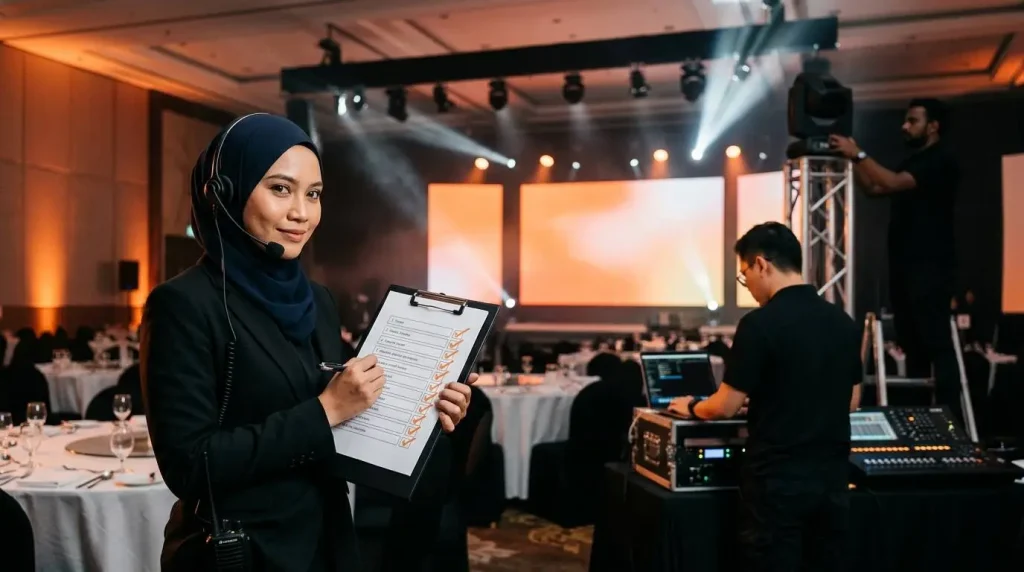
A corporate event planning checklist for Malaysia must cover nine phases. These are your objective, budget, and date, lead time, venue, permits, food and beverage, vendors, guests, and attendee data, event-day control, and the debrief.
Attendee data falls under Malaysia’s Personal Data Protection Act (PDPA), the law that controls how companies collect, use, and protect people’s personal information. Most checklists online miss this local layer, which breaks Malaysian budgets and timelines.
Here is the problem. Generic checklists are written for companies that never worry about Ramadan dates, DBKL permits, JAKIM halal certificates, or an 8% service tax line that appears after the budget is already approved. Malaysian planners deal with all four, often in the same month.
This blog gives you the full checklist, phase by phase, with tables for dates, lead times, and costs. It draws on what we see in the field as a professional event and conference management team that has run over 2,500 events in Malaysia since 2004. A printable version is at the end of this blog for you.
What a Malaysian Corporate Event Checklist Has to Cover
A complete corporate event planning checklist in Malaysia moves through nine phases, from setting one clear goal to writing the post-event debrief. Each phase is explained in detail further down in this blog.
- Objective, budget and date. Set one measurable goal, budget in nett figures, and pick a date that avoids festive clashes.
- Lead time. Start 6 weeks to 18 months ahead, depending on event size and type.
- Venue. Check capacity in your real layout, F&B minimums, and AV exclusivity before you sign.
- Permits. Confirm council, Bomba, foreign talent, and music licensing needs early.
- Food and beverage. Verify halal certification and plan for every dietary need in the room.
- Vendors. Compare scope, payment terms, cancellation clauses, and e-invoice readiness.
- Guests and attendee data. Send invitations, track RSVPs, and collect registration data with proper consent under the PDPA.
- Event day. Run from one run sheet with one named decision maker.
- After the event. Collect feedback, settle invoices, and write the debrief.
Lock Your Objective, Budget, and Date Before Anything Else
Your objective, budget, and date decide every other choice on this checklist. Lock these three first, and venue, format, and vendors become much easier to pick.
Define One Measurable Objective, Not Four
A good event objective is one specific target you can measure after the event. “Raise morale” is a wish. “Get 85% attendance from our 400 staff and a post-event score of 8 out of 10” is an objective.
The objective shapes the format. A morale goal points to an annual dinner or family day. A sales goal points to a product launch or client evening. If your staff are spread across several branches, a hybrid event lets remote teams join live.
A vague objective leads to scope creep. Every stakeholder adds their own idea, and the budget grows with each one.
Set the Budget in Nett, Not Nominal
A realistic corporate event budget Malaysia finance teams can approve is always set in nett figures, meaning the final amount after tax and service charges. Many vendor quotes arrive with tax added later, so a budget approved on quoted figures often runs short at settlement.
Here is how service tax usually applies to event spending in Malaysia, based on the Malaysian Association of Convention and Exhibition Organisers and Suppliers (MACEOS) guidance on the July 2025 SST expansion.
| Cost Type | Service Tax Rate | Vendor Registration Threshold |
| Event management and planning fees | 8% | RM500,000 taxable turnover a year |
| Venue hall rental, AV and equipment hire | 8% | RM1,000,000 taxable turnover a year |
| Banquet and catering (non-alcoholic F&B) | 6% | RM1,500,000 taxable turnover a year |
The threshold explains why one vendor charges tax and another does not. A vendor below its threshold does not need to register, so it should not charge SST at all.
Hotels often add their own service charge on top, commonly around 10%, as covered in our breakdown of event management cost in Malaysia.
Suppose your vendors quote RM120,000 in total and every line is taxable at 8%. Your real bill becomes RM129,600. That RM9,600 gap is exactly why finance teams get surprised. Before you approve anything, ask every vendor whether the quote is nett or plus plus.
Pick a Date That Survives the Malaysian Calendar
The right date avoids festive seasons that pull your guests away. In 2027, Chinese New Year, Ramadan, and Hari Raya Aidilfitri all fall within about five weeks of each other, so the first quarter needs careful planning.
Chinese New Year falls on 6 to 7 February 2027, with 8 February as the replacement holiday. Ramadan is expected to begin around the same time. Hari Raya Aidilfitri follows on 10 and 11 March 2027.
During Ramadan, fasting guests will skip lunch events, and evening events can clash with breaking fast. A buka puasa dinner timed around sunset works well instead. After Raya, a company Raya open house in March or April is a strong morale event.
Thaipusam on 22 January 2027 catches many planners out. It is a holiday in Kuala Lumpur, Selangor, Putrajaya, and several other states, but not a national one.
Then there is the November to December annual dinner crush. Ballrooms fill fast, and prices rise with demand, which our gala dinner planning team sees every year.
Here is a month-by-month planning guide for the next 15 months.
Lunar and Islamic holiday dates are provisional until moon sighting and the official gazette.
| Month | Key Dates | Good For | Avoid |
| Oct 2026 | Inter-monsoon storms | Seminars, indoor conferences | Outdoor events in the afternoon |
| Nov 2026 | Deepavali, annual dinner season starts | Annual dinners booked early | Late ballroom hunting |
| Dec 2026 | Christmas, year-end leave | Annual dinners, year-end parties | Events in the last two weeks |
| Jan 2027 | Thaipusam 22 Jan (KL, Selangor and more) | Kick-off meetings, sales conferences | 22 Jan in affected states |
| Feb 2027 | CNY 6 to 8 Feb, Ramadan begins (est.) | Lo hei lunches before CNY, buka puasa dinners | Lunch events and daytime F&B during Ramadan |
| Mar 2027 | Aidilfitri 10 to 11 Mar | Buka puasa early in the month, Raya open houses late | The week around Raya |
| Apr 2027 | Raya season continues | Raya open houses, conferences | Outdoor afternoons (storms) |
| May 2027 | Labour Day, Hari Raya Haji 17 May, Wesak 20 May | Product launches, conferences | Long weekends |
| Jun 2027 | Awal Muharram and the Agong’s Birthday, early June | Mid-year town halls | The early June long weekend |
| Jul 2027 | No national holidays | Team building, family days, conferences | Very little |
| Aug 2027 | Maulidur Rasul 15 Aug, Merdeka 31 Aug | Merdeka-themed staff events | The end of the month |
| Sep 2027 | Malaysia Day 16 Sep, haze risk | Indoor events | Outdoor events on high haze days |
| Oct to Dec 2027 | Deepavali, annual dinner peak | Annual dinners booked 6 to 12 months ahead | Last-minute bookings |
How Far Ahead to Start, by Event Type
Most corporate events in Malaysia need 6 weeks to 18 months of planning, depending on size and complexity. Bigger events need longer lead times because the best venues and crews are booked first.
This corporate event planning timeline shows how far in advance to plan a corporate event by type.
| Event Type | Recommended Lead Time |
| Quarterly team dinner | 6 to 12 weeks |
| Mid-size company event or seminar | 3 to 6 months |
| Annual dinner or 300+ pax gala | 6 to 12 months |
| Multi-day conference | 9 to 18 months |
Add 4 to 8 weeks to these figures in three cases. These are events with foreign talent, events at a non-standard outdoor venue, and events on a festive-season date.
Permits and ballrooms both go first in these situations. For a mid-size format, our guide to organizing a corporate seminar shows how the steps fit into a 3 to 6 month window.
Venue Checklist: What to Verify Before You Sign
A venue is only right if it works for your exact layout, budget, and guests. Check the fine print before you pay a deposit, because the contract terms decide your real cost.
The 12 Questions That Decide Whether a Venue Works
Ask these 12 questions at the site visit and get the answers in writing. Each one has broken a budget or a run sheet at some point.
- What is the capacity in our layout?
Banquet rounds often hold around a third fewer guests than theatre rows in the same room.
- What is the F&B minimum spend?
Know the figure before you choose a menu.
- Is AV in-house only?
Some venues ban outside AV suppliers.
- What are the load-in access and lift sizes?
Large stage sets and LED panels must fit through doors and lifts.
- What is the ceiling height?
Staging, rigging, and LED walls need clear height.
- Is the power supply enough?
Big productions may need a separate generator set.
- What is the parking ratio?
Poor parking hurts attendance on a weekday evening.
- Is there a prayer room nearby?
Long programmes need a surau within easy reach.
- What are the cancellation terms?
Know what you lose at each stage.
- What are the postponement terms?
Postponing is not the same as cancelling in most contracts.
- When can we set up and rehearse?
Some venues only release the hall hours before doors open.
- What is the venue’s fire certificate status?
Temporary setups must not block fire exits.
Read the F&B Minimum and the AV Exclusivity Clause Twice
These two clauses cause most venue budget overruns. Read both before you sign, not after.
Some hotels bundle AV at rates well above the rental market and do not allow outside suppliers. A high F&B minimum can force a menu upgrade nobody wanted just to meet the figure. Negotiate both at the quote stage, when you still have bargaining power.
Indicative KL Cost Ranges
Corporate event costs in Kuala Lumpur vary widely with headcount, date, and production scope. The ranges below come from Genio’s published 2026 pricing benchmarks for full-service event management.
| Event Scale | Typical Full-Service Range |
| Small corporate event (50 to 100 pax) | RM15,000 to RM35,000 |
| Annual dinner or awards night (100 to 300 pax) | RM40,000 to RM150,000 |
| Venue and catering package for mid-size dinners | RM150 to RM300 per pax |
| Large production (300+ pax) | From RM150,000, often past RM500,000 |
Treat these as starting points, not quotes. The same corporate event venue Kuala Lumpur companies book cheaply on a Tuesday in July can cost far more on a Friday in December. Real prices depend on your headcount, date, and inclusions.
Permits, Licences and Approvals: The Malaysian Compliance Layer
Event permit Malaysia rules depend on where you hold the event and who performs. Most in-house corporate events at a licensed hotel need nothing extra, but once you move outdoors, into public space, or bring in foreign talent, several approvals apply at once.
Local Council Approval (DBKL, MBPJ and Others)
Local council approval is needed for outdoor events, public spaces, roadshows, temporary structures, and road closures. Each council sets its own rules, so check with the one that covers your site.
Councils typically ask for company documents, site plans, floor plans, and layout drawings. Kuala Lumpur City Hall (DBKL), for example, runs a temporary road closure permit for events held by private companies. Plan for approval to take weeks, not days.
Fire Safety and Temporary Structures
Bomba clearance applies to tents, marquees, staging, and rigging at many events. Crowd capacity and exit planning also come under fire safety review.
Temporary builds must never block fire exits or firefighting equipment. Pyrotechnics and stage effects need their own approval, so start early. Our guide to Bomba requirements for large events walks through the full process.
Foreign Speakers, Artists and Performers (PUSPAL)
Foreign artists and performers need PUSPAL approval before their work pass application can go to Immigration. PUSPAL is the government centre that approves filming and performances by foreign artists in Malaysia.
The Immigration Department states that PUSPAL approval must come before the Professional Visit Pass application. It also asks for pass applications at least one month before the start date.
Allow 8 to 12 weeks of real runway in total. PUSPAL guidelines also cover performer conduct and dress, so write these into the artist contract. Foreign speakers who do not perform should confirm the right pass with Immigration.
Our artist and talent management team handles this process for foreign acts.
Music Licensing (MACP, PPM, RPM)
Playing recorded music or having a band cover copyrighted songs at a company dinner counts as a public performance. It needs a licence, and this is the approval almost everyone misses.
Three separate bodies collect for different rights holders. MACP covers songwriters, composers, and publishers. PPM covers the recording companies behind sound recordings.
RPM covers the recording performers. Some hotels and venues already hold these licences. At a private or non-traditional venue, the licence may fall on you. Ask the venue to confirm its music licensing in writing.
Public Liability Insurance
Public liability insurance covers claims if a guest is injured or property is damaged at your event. Many venues ask for proof of cover before they confirm a booking.
Your vendor’s insurance certificate protects the vendor, not your company. If a guest trips over a cable, the claim may land on you as the organizer.
Check whether your corporate policy covers off-site events, or buy event-specific cover.
Food and Beverage: Halal, Dietary and Cultural Requirements
In a mixed Malaysian workforce, F&B is where small mistakes cause the biggest offence. Verify halal status properly, then plan for every dietary need in the room.
Verify Halal Certification, Don’t Assume It
“Pork-free” does not mean halal certified. Halal catering for corporate events should come from a kitchen certified by JAKIM or a state Islamic religious authority.
Check three things before you sign. The certificate must be current. It must be issued by JAKIM or a recognized state authority. It must cover the specific kitchen or outlet cooking your food, because one hotel may hold certificates for some kitchens only.
You can check any premises on the official Malaysia Halal Portal. If a certified caterer serves at a venue with an uncertified kitchen, ask how the food is prepared and transported, and get the answer in writing.
Plan for the Actual Room
Your menu should work for every guest at the table, not just the majority. List every dietary need at registration, then brief the caterer early.
- Vegetarian and Hindu guests. Many Hindu guests avoid beef, and vegetarians need full meals, not side dishes.
- Non-alcoholic options. Serve good mocktails, and keep alcohol service away from Muslim guests’ tables if alcohol is served at all.
- Ramadan timing. Start buka puasa dinners so food is ready at sunset, and plan a short break for Maghrib prayers.
- Prayer space and timing. Long programmes should leave room for prayer times, with a surau nearby.
Vendors and Procurement: What to Ask Before You Commit
Good vendor choices protect your budget, your timeline, and your company’s reputation. Ask the same questions of every vendor, so you can compare quotes fairly.
The Vendor Shortlist Checklist
Shortlist only vendors who can prove they have delivered events like yours. Use this list for every shortlisted company.
- Company registration. Confirm the business is registered with SSM.
- Portfolio. Ask for events of a similar size and type.
- Insurance. Request a current insurance certificate.
- Named crew. Know who will actually be on site.
- Backup equipment. Ask what happens if a projector or mic fails.
- Clear scope. Get a written list of what is in and out of the price.
For more on judging partners, see our tips on how to choose the right event planner in Malaysia.
Payment Terms, Deposits, and Cancellation
Deposit, postponement, and cancellation terms decide how much money you lose if plans change. Agree on them in writing before you pay anything.
Many vendors ask for a deposit on signing, with the balance due before or soon after the event. Check whether you can postpone without losing the deposit, since postponement and cancellation are often priced differently. Read the force majeure clause closely. A good one names real events, such as floods, government restrictions, or venue closure, and says what each party owes.
e-Invoice: Check This Before the Finance Team Does
Ask every vendor whether they issue e-invoices validated by LHDN. Your finance team needs proper e-invoices to support the event expense.
On 30 August 2026, the government raised the e-invoice exemption threshold from RM1 million to RM3 million in annual turnover. Smaller vendors below this level may now be exempt, subject to LHDN’s conditions.
In some cases, such as buying services from a foreign supplier, your company must issue a self-billed e-invoice itself. Similar rules can affect payments to foreign speakers and some freelancers, such as emcees and photographers.
The thresholds have changed several times, so confirm the treatment with your tax adviser using LHDN’s latest e-Invoice guidance.
One Vendor or Many?
Managing 8 to 12 vendors yourself gives you full control and can cost less for simple events. Partnering with an experienced event management agency in Malaysia saves time and reduces the risk of gaps between suppliers.
Direct booking genuinely saves money for small, simple events, such as a team dinner at one restaurant. It gets harder as production grows. Each outside vendor adds its own margin, and you become the person holding every contract when something fails on the night.
For larger events, one partner with in-house staging, sound, and lighting removes layers of markup and finger-pointing. You can see how that works across our event management services.
Attendee Data, Registration, and PDPA
Guest management starts with clear invitations and ends with a reliable headcount. Because registration collects personal data, the PDPA also applies to your event.
Send Invitations and Track RSVPs
A clear invitation schedule gives you an accurate headcount before the venue’s deadline. Late or vague invitations are the main reason final numbers keep changing.
- Save the date. Send it as soon as the date is locked, and at least 6 to 8 weeks ahead for an annual dinner.
- Formal invitation. Send it with a firm RSVP deadline about 3 to 4 weeks before the event.
- Ask the right questions. Use the RSVP form to collect dietary needs, accessibility needs, and transport or parking needs.
- Send reminders. Remind guests one week before and again the day before, by email and WhatsApp.
- Confirm the headcount. Give the venue your final number by its guarantee deadline, which is often a few days before the event.
For staff travelling from other states, plan transport and hotel rooms early, especially on festive-season dates.
Keep Registration Data PDPA-Safe
Every registration form creates a legal duty for your company under the PDPA. Few checklists mention it, yet a data leak from an event list can reach thousands of people.
Your company is the data controller, even if a third-party registration platform collects the data for you. Keep these points in your plan.
- Clear consent. Tell guests what data you collect and why at the point of registration.
- Purpose limits. Use the data only for the event, unless guests agree to more.
- Breach notice. Since 1 June 2025, a notifiable data breach must be reported to the Personal Data Protection Commissioner within 72 hours.
- Photo and video consent. Tell guests that photos will be taken, and offer a simple way to opt out.
- Vendor contracts. Add a data protection clause to your registration vendor’s contract, so they must report any breach to you quickly.
The Run Sheet and Event-Day Checklist
A clear run sheet and one decision maker keep event day calm. Everyone should know what happens next, who owns it, and what to do if it fails.
Building a Run Sheet People Can Actually Follow
A good run sheet lists every moment of the event in time order, with an owner for each item. Keep it to the columns people really use on the day.
| Time | Item | Owner | Cue | Backup |
| 7:30 pm | CEO welcome speech | Emcee | Walk-in music fades | Emcee reads a short welcome |
Schedule a full rehearsal with the AV team. Do a soundcheck for every mic and video. Brief every speaker on timing, stage entry, and slide control.
Our guide to event logistics planning covers the behind-the-scenes coordination in more depth.
Event-Day Morning Checklist
The morning of the event is for checking, not planning. Work through this list with your core team before guests arrive.
- Load-in. Confirm every vendor’s arrival time and loading bay slot.
- Registration desk. Set up lists, badges, and QR scanners.
- AV check. Run every video, mic, and slide once more.
- F&B headcount. Reconfirm final numbers with the kitchen.
- Signage. Check directions from the car park to the hall.
- Safety and first aid. Brief security, mark the first aid point, and confirm every crew member knows the emergency exits.
- Contingency. Plan for rain and traffic. KL traffic on a Friday evening is a scheduling input, not an excuse.
Who Makes the Call When Something Breaks
One person must have the final say on event day. Name them before the event, and make sure every vendor knows who it is.
Use one contact list and one WhatsApp group for all crew and vendors. Problems get solved in minutes when everyone knows where to report them.
After the Event: The Part Most Companies Skip
The post-event phase turns one event into a better event next year. Most companies skip it, and that is why the same mistakes repeat.
- Collect feedback within 48 hours. Send a short survey while memories are fresh.
- Reconcile final invoices. Compare every bill against the approved nett budget.
- Secure your assets. Get photos and videos delivered with clear usage rights.
- Write the debrief. Record what worked, what failed, and what to change.
Go back to the measurable objective you set at the start. Record whether you hit 85% attendance and the target score. That answer, written down, becomes the starting point for next year’s plan. Our event planning guide has more on turning debriefs into better events.
Download the Checklist
Use this condensed checklist as your annual dinner planning checklist or for any corporate event. Print it, share it with your team, and tick off each item as you go.
| Phase | Must-Do Tasks |
| 1. Objective, budget and date | One measurable goal, nett budget, festive calendar check |
| 2. Lead time | Book to match event size, plus 4 to 8 weeks for foreign talent or festive dates |
| 3. Venue | 12 venue questions answered in writing, F&B minimum and AV clause checked |
| 4. Permits | Council, Bomba, PUSPAL, music licences, and insurance confirmed |
| 5. Food and beverage | Halal certificate verified, dietary list sent to caterer |
| 6. Vendors | Scope, deposit, cancellation terms, and e-invoice status agreed |
| 7. Guests and attendee data | Invitations and RSVP deadline sent, PDPA consent on forms, data clause in vendor contract |
| 8. Event day | Run sheet, rehearsal, one decision maker, one WhatsApp group |
| 9. After the event | Survey, invoice check, asset handover, written debrief |
Final Thoughts
Good corporate event planning Malaysia style comes down to handling local details early. Set one clear goal and budget in nett figures. Check the festive calendar before you lock a date. Confirm permits, halal status, and PDPA consent long before event day. If you want one team to handle it all, talk to Genio about your next event.
Some Common FAQs on The Corporate Event Planning Checklist
How far in advance should you plan a corporate event in Malaysia?
Plan 6 to 12 weeks ahead for a team dinner and 3 to 6 months for a mid-size company event. Annual dinners and galas need 6 to 12 months, and multi-day conferences need 9 to 18 months. Add 4 to 8 weeks for foreign talent, outdoor venues, or festive-season dates.
How much does a corporate event cost in Malaysia?
Full-service corporate events typically start around RM15,000 for 50 to 100 guests. Annual dinners for 100 to 300 guests often cost RM40,000 to RM150,000. Large productions can pass RM500,000. Always compare quotes in nett figures, after tax and service charges.
Do you need a permit to hold a corporate event in Malaysia?
Most indoor corporate events at a licensed hotel need no extra event permit. You may need approvals for outdoor events, public spaces, temporary structures, road closures, foreign performers, or music use. Check with the local council, Bomba, and PUSPAL as early as possible.
Is service tax charged on event management services?
Yes. Event management fees are taxable at 8% when the vendor is registered for SST, which applies once its taxable turnover passes RM500,000 a year. Venue and equipment rental is also taxed at 8%, while F&B services are taxed at 6%. A vendor below its registration threshold should not charge SST.
Do I need a licence to play music at a company dinner?
Yes, playing copyrighted music at a company dinner is a public performance that needs a licence. MACP, PPM, and RPM each collect for different rights holders. Some venues already hold these licences, so ask yours to confirm this in writing.
What is the best month to hold a corporate annual dinner in Malaysia?
November and December are the most popular months, but ballrooms fill early and cost more. January works well if you avoid Chinese New Year and Thaipusam dates. Whatever month you choose, book 6 to 12 months ahead.
Do we need halal-certified catering for a company event?
If Muslim staff or guests will attend, halal-certified catering is the safe and respectful choice. “Pork-free” is not the same as halal certified. Check that the certificate is current, issued by JAKIM or a state Islamic authority, and covers the kitchen cooking your food.la