
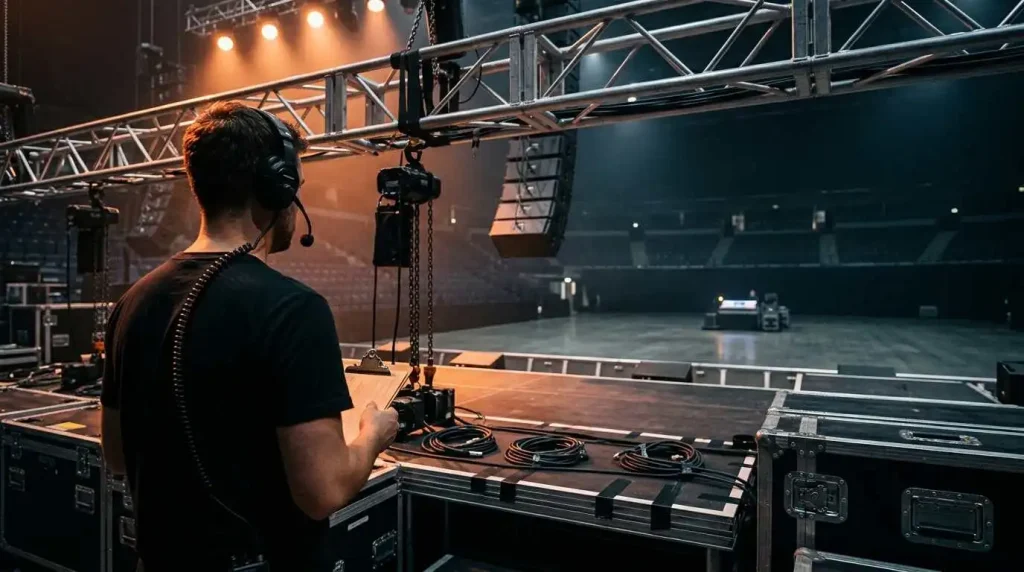
Live event production covers everything that happens between booking an artist and the last truck leaving the venue. It runs across three phases, pre-production planning, the technical build on site, and running the show live, and most of that work happens long before any ticket holder walks through the door.
A concert audience sees two or three hours of finished show. What they do not see is the site survey from weeks earlier, the trucks that rolled in eight to twelve hours before doors opened, and the dozens of specialists who built, ran, and tore down the entire production around them.
Concert production runs on a strict order, and this blog goes through that order exactly as it happens.
What “Live Event Production” Actually Covers
Live event production is the umbrella term for everything that turns an artist booking into a finished show. It is a different job from event planning or event management, which focuses on the guest list, the venue contract, and the catering order.
A live event producer focuses on the stage presentation itself and the technical systems that support it.
That work breaks down into three stages, and everything you see backstage at a concert fits into one of them. The rest of this guide follows them in order.
- Pre-production: booking, technical rider, site survey, permits
- Load-in and build: trucks arrive, rigging goes up, systems get built
- Show and strike: soundcheck, doors, live performance, teardown
Weeks Before Doors: The Pre-Production Work Nobody Sees
Pre-production covers the site survey, the venue assessment, and the vendor and crew bookings that happen long before load-in day.
A venue that looks perfect on a floor plan can turn out to have a low ceiling, no loading dock, or a stage door too narrow for a truss case, so a physical site survey catches problems while there is still time to fix them.
This phase also produces two documents a show cannot run without. A technical rider is what the artist or their team sends ahead of the show, listing every microphone, monitor, and piece of backline equipment the stage needs.
The stage plot is the diagram inside that rider, showing exactly where each performer, amp, and monitor sits on stage. Without both, a show cannot be properly advanced, and advancing simply means confirming every technical and logistical detail with the venue before the trucks even leave the warehouse.
Vendor and crew booking happens in parallel with this. Sound, lighting, staging, and rigging companies all need to be locked in weeks ahead, and so does the talent itself, which is the kind of coordination an experienced event organizer in Malaysia handles as a matter of routine.
Working with an established artist and talent management partner at this stage means the technical rider arrives early and the right specialists are already booked before load-in week starts.
Permits and safety planning also start here, not on load-in day. Crowd capacity limits, fire safety clearance, and approval for any special effects all need sign-off before the show can go ahead, and starting that process late is one of the most common reasons a load-in day turns into a scramble.
Load-In: Turning an Empty Room Into a Concert Venue
For a full production, load-in typically starts eight to twelve hours before doors open, and arena-scale shows with heavy rigging can stretch to sixteen or twenty hours. Club shows with less equipment and no rigging compress that window down toward the shorter end.
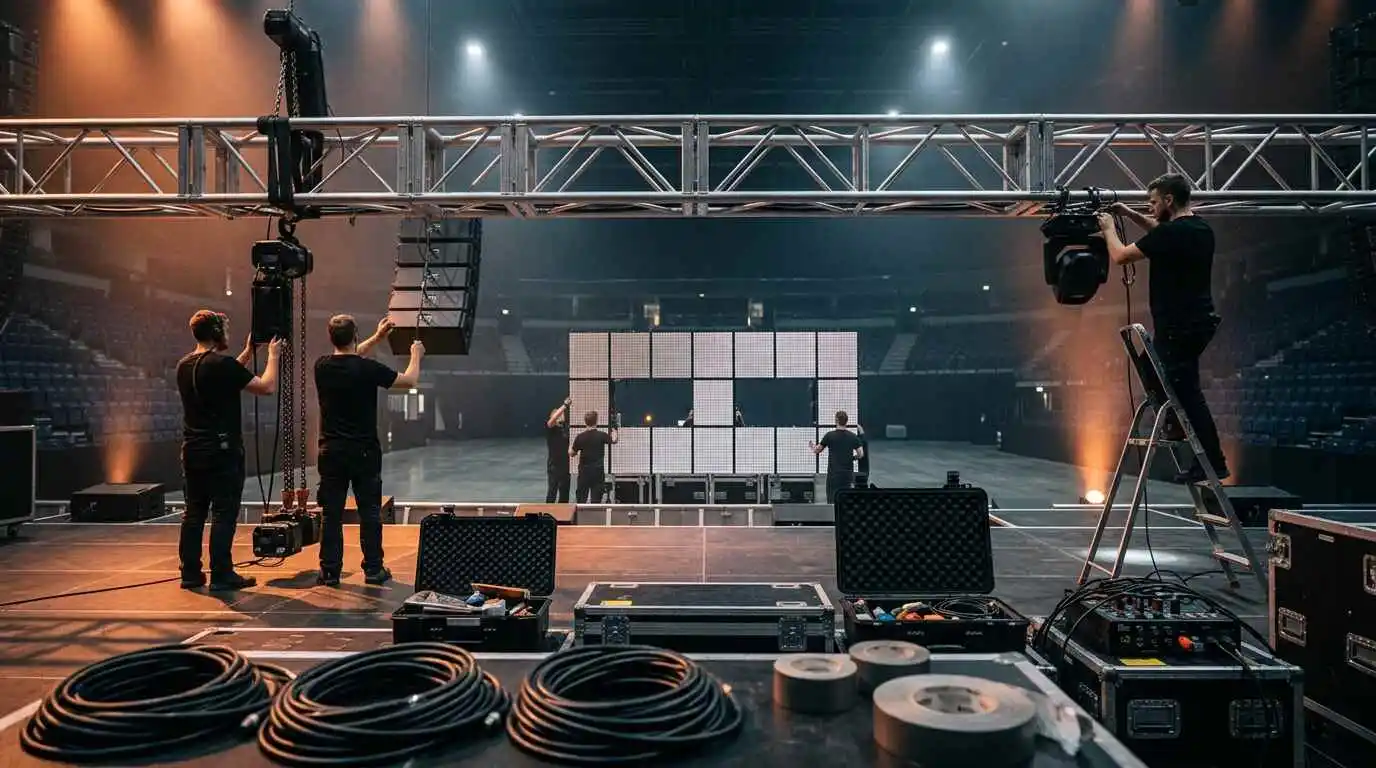
Trucks do not arrive all at once. They arrive in a set order, staging first, then audio, then lighting, then video, because each department depends on the one before it being physically in place.
The crew call is the time every department needs to be on site and ready to work, and it kicks off a day that has already been mapped out to the hour.
Good event logistics planning is what makes this order possible in the first place, since dock access, parking, and arrival times were all confirmed days earlier, not figured out on the morning of the show.
Rigging, Sound, Lighting and Video: Building the Systems
Riggers are the first technical department to work, climbing into the venue grid or arena steel to hang motors and trussing before anything else can go up.
Every speaker cluster, lighting fixture, and video wall that ends up hanging over the crowd depends on a rigging point a rigger installed and tested first.
While that happens overhead, the staging crew builds the physical stage and risers on the floor below, in a separate zone, since nobody works directly under active rigging.
| Department | What They Build |
| Rigging | Motors, chain hoists, and trussing that everything else hangs from |
| Audio | The PA system and speaker arrays, tuned to the room |
| Lighting | The lighting rig, including fixtures, truss positions, and control desk |
| Video | LED walls, screens, and camera feeds for the audience |
| Power | Distribution that keeps every department running without a trip |
Soundcheck: Line Check vs. Artist Soundcheck
Soundcheck is not one single step. It is two separate steps that happen back to back, a line check and an artist soundcheck, and skipping the first one is usually why the second one runs long.
The line check comes first, and it belongs to the audio engineers alone. They confirm that every microphone and line input actually reaches the console and produces a clean signal, one channel at a time, with nobody dialing in a mix yet.
Once the line check is done, the artist steps on stage for the soundcheck itself, where engineers dial in the front-of-house mix, the sound the audience hears, and the monitor mix, the sound each performer hears through their wedge or in-ear monitor.
This is where problems like feedback, a buried vocal, or a performer who cannot hear their own instrument usually surface, and it is exactly why a rushed line check turns a thirty-minute soundcheck into an hour.
Who’s Backstage: The Roles Behind a Concert
A behind the scenes concert crew carries more job titles than most audience members would guess, and each one owns a specific slice of the show.
The table below covers the roles you will find on almost every production, from the person who plans the whole day to the crew who build and strike the physical stage.
| Role | What They Do |
| Production manager | Runs the overall schedule and budget from advance through strike |
| Stage manager | Calls every cue during the show from the stage wing |
| FOH engineer | Mixes the sound the audience hears, live, throughout the performance |
| Monitor engineer | Mixes what each performer hears on stage |
| Lighting designer/operator | Designs and runs the lighting cues |
| Riggers and stagehands | Build and tear down the physical structure |
| Tour manager | Manages the artist’s schedule, travel, and day-to-day needs |
| Production assistant | Supports every department with logistics on the day |
Front of house refers to the mixing position out in the crowd, where the FOH engineer controls what the audience hears, along with the audience-facing parts of the venue.
Backstage, sometimes called back of house, covers everything behind the curtain, the dressing rooms, the wings, and the technical positions the audience never sees.
The two sides talk constantly through intercom but rarely see each other once the show is running.
Doors to Encore: Running the Show Live
Once doors open, the show runs on cues, not chaos, and the stage manager is the person holding it together.
From the stage wing, they call every cue over the intercom, telling lighting when to change, telling audio when a segment starts, and telling the next act when to walk on.
The FOH engineer is just as active. Rather than setting the mix once and leaving it, they ride the mix in real time throughout the performance, adjusting levels and effects as the room fills up and the energy of the show changes.
On a multi-act bill, changeovers between performers typically take fifteen to thirty minutes, tighter on a festival stage running a strict schedule and longer for a headline change that involves a full stage reset.
The same discipline that keeps a concert changeover tight is what keeps a well-run gala dinner in Malaysia moving between segments without a dead moment on stage.
Strike: Tearing It Down
When the last song ends, strike begins immediately, and it moves fast. The process reverses the load-in sequence, backline comes off stage first, then video, audio, and lighting fixtures are de-rigged, and truss comes down last.
A full load-out can take anywhere from two to six hours depending on the size of the production.
What happens after that split point depends entirely on the type of show. Touring productions load straight onto trucks that need to be on the road to the next city that same night.
One-off events send their gear back to a warehouse instead, since there is no next stop on a tour to reach by morning.
Every part of this behind-the-scenes concert process, from the first site survey to the last truck pulling away, is what separates a show that looks effortless from one that actually runs that way.
Working with an experienced Event Organizer in Malaysia means all of it, the rider, the rigging, the soundcheck, and the strike, is handled by people who have done it enough times to make it look easy.
Wrapping Up: Why the Best Productions Look Effortless
Live event production succeeds when nobody in the audience notices it happening.
Every stage covered in this concert’s behind-the-scenes breakdown- the pre-production paperwork, the load-in order, the two-part soundcheck, the roles working behind the curtain, and the fast teardown at the end- exists to protect the two or three hours the crowd actually came for.
None of that happens by accident. It happens because an experienced Event Management Company in Malaysia has run this exact sequence enough times to make it look easy, even when the room was still empty twelve hours before doors opened.
Frequently Asked Questions on Live Event Production
How many people actually work behind the scenes at a concert?
It depends heavily on the size of the show. A small production might run on a handful of specialists, while a full arena show with rigging, video, and broadcast can involve several dozen crew members across a dozen or more roles.
What is a technical rider and stage plot, and why do they matter?
A technical rider lists every technical need for the show, from microphones to backline equipment, and the stage plot is the diagram showing where each performer and piece of gear sits on stage. Without both, a venue cannot properly advance the show before load-in day.
How long does it take to set up for a concert?
A full production typically needs eight to twelve hours of load-in before doors open. Arena shows with heavy rigging can take sixteen to twenty hours, while smaller club shows with less equipment finish closer to the shorter end.
What’s the difference between front of house and backstage?
Front of house is the crowd-side mixing position where sound and lighting are controlled during the show. Backstage sits on the other side of the curtain entirely, covering dressing rooms, the wings, and every technical position the audience never sees.
Why does soundcheck happen before doors open instead of during the show?
Soundcheck exists to catch problems, feedback, a buried vocal, a monitor mix that is not working, before an audience is in the room to hear them. Doing that work during the actual performance would mean every mistake happens live instead of getting fixed in advance.